Address
No.4 Wenhua Road, Lanshan District, Rizhao City, Shandong, China
Work Hours
Monday to Friday: 7AM - 7PM
Weekend: 10AM - 5PM
Address
No.4 Wenhua Road, Lanshan District, Rizhao City, Shandong, China
Work Hours
Monday to Friday: 7AM - 7PM
Weekend: 10AM - 5PM
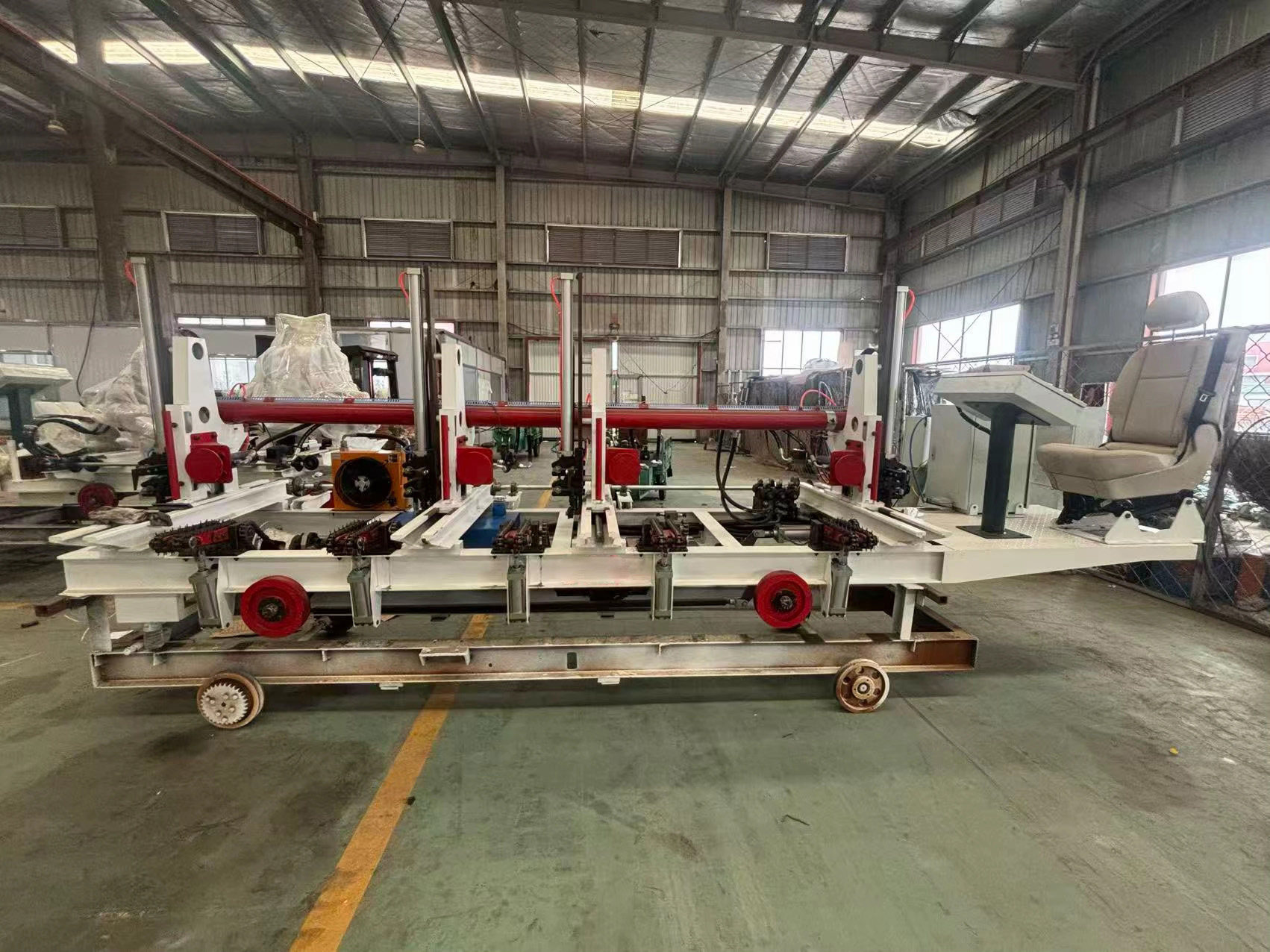
In the competitive world of timber processing, every fraction of a log that turns into usable lumber directly impacts the bottom line. For sawmill operators worldwide, the sawmill carriage—often referred to as the log carriage—has emerged as an indispensable component of modern wood processing. But what exactly is a bandsaw carriage, and why are sawmills around the globe increasingly investing in this technology?
What Is a Band sawmill Carriage?
A sawmill typically consists of three main components: a bed, a carriage, and a saw head. The bandsaw carriage is the mechanism that holds and moves the log through the cutting process. Mounted on a track that runs parallel to the saw blade, the carriage transports the log steadily and precisely past the band saw.
Modern bandsaw carriages have evolved far beyond simple log-moving platforms. Today’s systems feature hydraulic or computer-controlled automation, allowing for precise positioning, automated feeding, and even computerized setworks that determine cutting parameters. Some advanced carriages incorporate 3D scanning technology to analyze each log’s internal characteristics and generate optimized cutting instructions in real time.
The Benefits of Using a Band sawmill Carriage
1.Superior Precision and Consistency
One of the most compelling advantages of modern bandsaw carriages is their exceptional cutting precision. High-quality automated carriage systems can maintain thickness accuracy within less than 0.2mm. Advanced CNC-controlled models can achieve precision as fine as ±0.5mm.
This level of accuracy is critical for sawmills producing dimensional lumber, furniture components, or other finished wood products where consistency is paramount. The stable, controlled movement of the carriage eliminates the variations that often occur with manual feeding methods, ensuring every cut meets specifications.
2.Maximized Lumber Yield and Reduced Waste
In the sawmill business, waste is the enemy of profitability. Bandsaw carriages help operators extract more usable lumber from every log through several mechanisms.
First, the thin kerf of bandsaw blades—typically removing only about 1mm (0.04″) of wood per cut—means less material is lost as sawdust compared to traditional circular saws. When combined with precise carriage positioning, this translates directly into more boards per log.
Second, advanced carriage systems with computerized controls can reduce material loss by approximately 15% compared to conventional saws. Some high-end systems can achieve waste reduction of up to 40% over manual operations.
Research has also demonstrated that bandsaw machines with integrated feed-carriage systems are a promising technique for increasing lumber recovery and improving surface quality. Studies from various sawmill operations show that band sawmills consistently achieve higher volume recovery rates compared to circular sawmills.
3.Increased Production Speed and Throughput
Time is money in any manufacturing operation, and bandsaw carriages deliver significant speed advantages. Hydraulic carriage systems enable high-speed cuts that dramatically accelerate processing times. Automatic CNC band sawing machines can achieve cutting speeds approximately 30% faster than manual band saws.
The vertical design of many modern band sawmills reduces log handling time by 20% compared to horizontal saws, while trolley carriage systems enable 30% faster log positioning than manual systems. For high-volume operations, these efficiencies compound into substantial production gains.
Furthermore, bidirectional cutting capabilities—where two band saws are mounted back-to-back on a carriage—eliminate the time required to return the saw head to its starting position between passes, producing more board feet per unit of time.
4.Labor Savings and Simplified Operation
Traditional sawmilling required skilled operators with years of experience to manually position logs and guide cuts. Modern bandsaw carriages have transformed this dynamic dramatically.
Automated carriage systems can be operated by a single worker. Computer-controlled interfaces make operation intuitive, allowing common workers to learn and operate the equipment without specialized sawing or blade maintenance expertise.
Full automation reduces manual adjustments by up to 50% compared to non-automated saws. Once cutting parameters are entered, the system can automatically and continuously complete the entire sawing process—from log positioning to finished boards—with minimal human intervention.
For sawmill operators facing labor shortages or rising labor costs, this automation represents a significant competitive advantage.
5.Enhanced Safety
Sawmills have historically been among the more hazardous industrial environments. Modern bandsaw carriages incorporate multiple safety features that protect operators and reduce workplace injuries.
Built-in safety features such as full blade guards, emergency stop systems, safety interlocks, and protective barriers help ensure safe operation and compliance with industry safety standards. Advanced models feature triple-lock safety systems that exceed industry standards.
Reciprocating carriage log band saws require specific safeguards along the in-feed and out-feed tracks, and modern systems are designed with these safety requirements in mind. The reduced need for manual log handling also means operators spend less time in proximity to moving blades and heavy timber.
6.Versatility Across Applications
Bandsaw carriages are not one-size-fits-all solutions—they come in configurations suited to diverse applications. From portable mills that can be transported between job sites to heavy-duty industrial systems capable of handling logs up to 1.5 meters in diameter, there is a carriage system for virtually every scale of operation.
Vertical band saw configurations excel at processing large beams and thick timber, while horizontal systems are favored for high-volume dimensional lumber production. Some systems feature inclined carriages (such as 17° or 18° designs) that allow for shock-free reception of sawn boards, improved log turning, and smoother material flow.
7.Future-Ready Technology
The global bandsaw machine market is projected to grow at a compound annual growth rate of approximately 4.3% to 5.7% through the early 2030s, driven by increasing demand for precision cutting and efficient machinery.
Modern bandsaw carriages are keeping pace with these trends through integration with Industry 4.0 technologies. 3D scanning and automatic log optimization systems analyze each log’s shape and internal features, generating optimized cutting instructions that maximize material yield. CNC-controlled systems with touchscreen interfaces allow for programmable presets and rapid parameter adjustments.
For sawmill operators looking to remain competitive in an evolving market, investing in advanced bandsaw carriage technology is not just an operational improvement—it’s a strategic necessity.
Conclusion
The bandsaw carriage has evolved from a simple mechanical sled into a sophisticated, computer-controlled system that delivers precision, efficiency, and safety. For sawmill operators worldwide, the benefits are clear: higher lumber yields, faster production, reduced labor costs, and safer working conditions.
As global demand for processed wood products continues to grow and sustainability concerns drive the need for maximum resource utilization, the bandsaw carriage will remain an essential tool for sawmills seeking to extract maximum value from every log. Whether you operate a small portable mill or a large industrial facility, the right bandsaw carriage system can transform your operation’s productivity and profitability.
