Address
No.4 Wenhua Road, Lanshan District, Rizhao City, Shandong, China
Work Hours
Monday to Friday: 7AM - 7PM
Weekend: 10AM - 5PM
Address
No.4 Wenhua Road, Lanshan District, Rizhao City, Shandong, China
Work Hours
Monday to Friday: 7AM - 7PM
Weekend: 10AM - 5PM

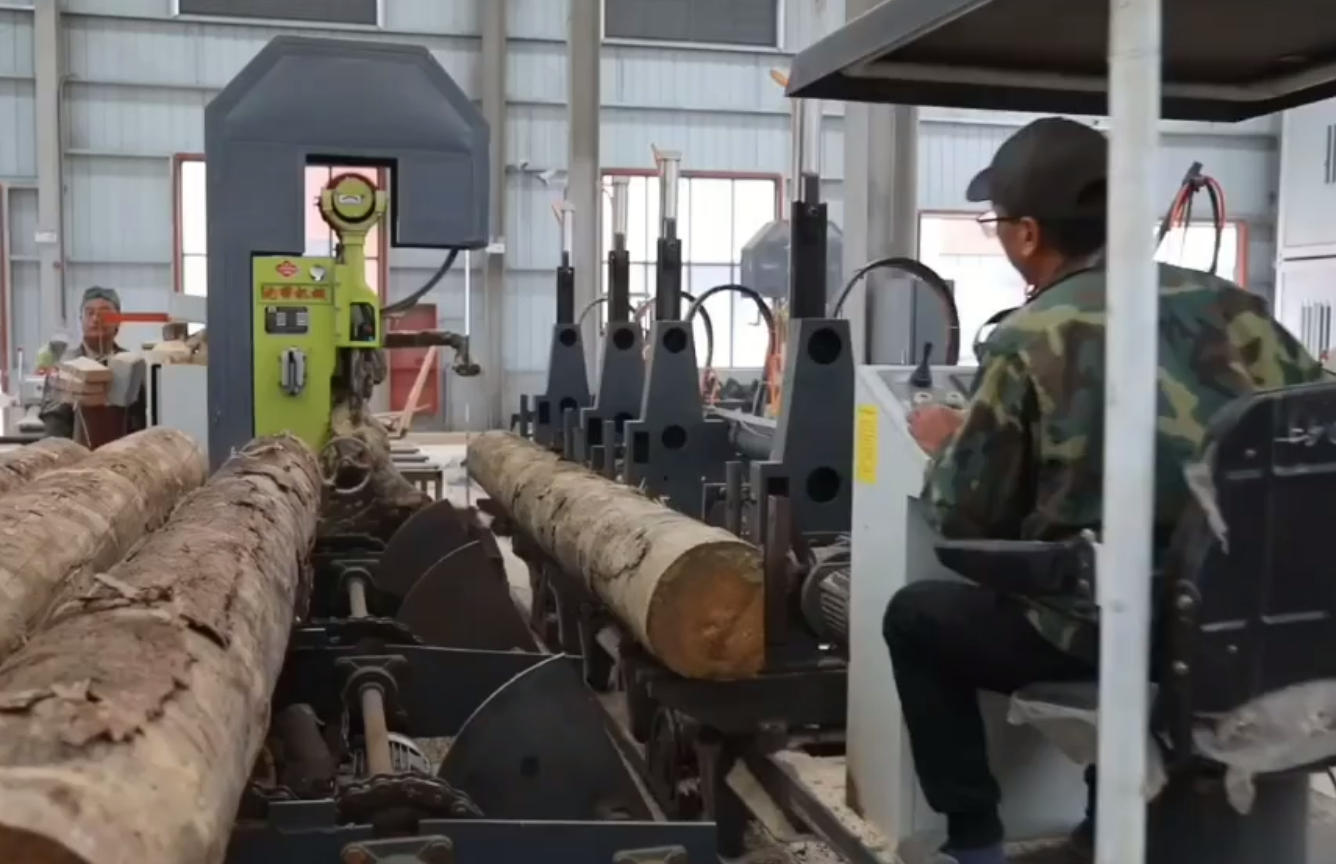
The log carriage band saw performs the initial processing step when timber arrives at the mill. Factors such as rising timber prices, increasing labor costs, and inherent safety risks associated with conventional band saws have driven the evolution of log carriage band saws toward intelligent manufacturing, leading to the mass adoption of new CNC models. Enterprises must be fully aware of the following operational considerations for these machines:
I. Pre-operation Checks
Saw Blade Condition: Inspect the blade for cracks (especially at the joint), missing teeth, or damage; use is strictly prohibited if side cracks exceed 10mm or joint cracks exceed 10mm.
Mechanical Fastening: Ensure bolts at all connection points are tight; verify that control handles operate smoothly and reliably and are in the neutral position; ensure rotating parts are unobstructed and lubricated according to specifications.
Parameter Calibration: Adjust blade tension to the appropriate level and maintain a side clearance of 0.15–0.25mm; check that cooling lines are clear and water spray volume is adequate.
Raw Material Cleaning: Remove embedded hard objects such as iron nails or stones from the logs to prevent tooth breakage or blade snapping.
II. Operational Safety Protocols
Positioning Requirements: Operators must stand on the sides of the saw; standing directly in front of the rotating saw wheels (the danger zone) is strictly prohibited; once the carriage starts moving, no one is permitted to stand near the track within its travel range.
No Adjustments During Operation: Set dimensions before the log enters the saw; adjusting the scale setting, saw guides, or clearing debris/bark while the log is being sawn is strictly prohibited.
Reversing Rules: Reverse the carriage only after the tail end of the timber has cleared the saw blade by at least 500mm; maintain a moderate speed to prevent knots from snagging or jamming the blade.
Handling Abnormalities: Immediately stop the machine to inspect if the blade wobbles, makes abnormal noises, or produces an uneven cut; operating the machine while it is malfunctioning is strictly prohibited.
III. Prohibited Actions and Protection
No Boarding/Alighting During Operation: Do not load or unload timber until the carriage has come to a complete stop; boarding or alighting from the carriage while it is in motion is strictly prohibited.
Hand Safety: Keep hands off the table surface during feeding; use a push stick when sawing short pieces; never pull or drag a broken saw blade directly with your hands.
Personal Protection: Wear protective gear such as safety goggles and ear muffs; tie back long hair; unauthorized personnel are strictly prohibited from operating the equipment.
Tension Adjustment: Do not attempt to stop blade oscillation by adding weight to the counterweight; instead, adjust the counterweight setting according to the saw blade specifications. IV. Shutdown and
Maintenance
Complete Stop: After operations conclude, wait until the saw blade has come to a complete stop before removing the timber or performing cleanup.
Power-Off Cleaning: Disconnect the power supply and clear away sawdust and dust; for prolonged shutdowns, reduce saw blade tension to minimize metal fatigue.
Routine Maintenance: Regularly inspect the hydraulic system, the tension of the traction steel cable, and the flexibility of the retraction mechanism (the retraction distance is typically maintained at 1.0–1.5 mm).
Note: All operators must undergo professional training before commencing work; unauthorized operation is strictly prohibited.
